


The International Licensing Examination for Hearing Healthcare Professionals (ILE) is the multiple-choice licensing examination owned and operated by the International Hearing Society (IHS). It is used as the written licensing exam for Hearing Aid Specialists by the majority of states and provinces across the United States and Canada.
Check with the licensing agency of your state/province to verify their process.
About the Exam
The ILE is practice-based, which means you’re expected to understand key concepts and use them to analyze critical information to reach the correct choice. Most exam questions will present a scenario for you to apply your knowledge of processes and relationships as you analyze the situation and devise an effective solution. Every question is referenced to the exam reference material, which is the IHS Distance Learning for Professionals in Hearing Health Sciences Course (2022 edition only).
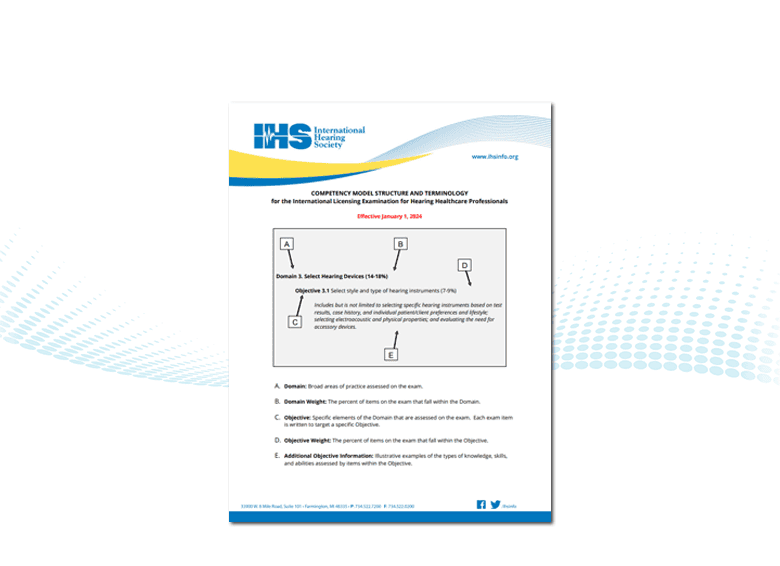
The exam includes 105 multiple-choice questions based on the Competency Model, which defines the exam content areas. Of these, 80 questions are scored and count toward your final result. The remaining 25 are unscored pilot questions and are used for exam development purposes. All questions are presented in random order, so you won’t be able to determine which ones are scored. You will have 120 minutes to complete the exam.
Eligibility and Exam Scheduling
Your licensing agency determines your eligibility to take the ILE. Eligibility requirements vary by jurisdiction, so please contact your licensing agency for information about how to become eligible to take the ILE. Once IHS receives notice of your eligibility from your licensing agency, you will receive scheduling instructions from IHS.

Preparing for the ILE
Each jurisdiction has their own laws, rules, regulations, and requirements for practice, training, and education prior to taking the licensing exam(s). For more information on those requirements, reach out to your licensing agency
How to Prepare
While the following are tips for success, the use of these tools, courses, and recommendations does not guarantee a passing score on the ILE.

Foundational Knowledge
Because the exam is practice-based, it is unlikely that you can be successful on the ILE without clinical experience. Both the academic training and workplace training pathways into becoming a Hearing Aid Specialist can provide the knowledge and skills needed to be successful. While receiving hands-on training, you must be supervised in accordance with the laws and rules of the licensing agency where you intend to practice.
Study Materials & Resources
Once you have completed your training and are deemed eligible by your jurisdiction to take the ILE, here are some important resources.
ILE Test Prep
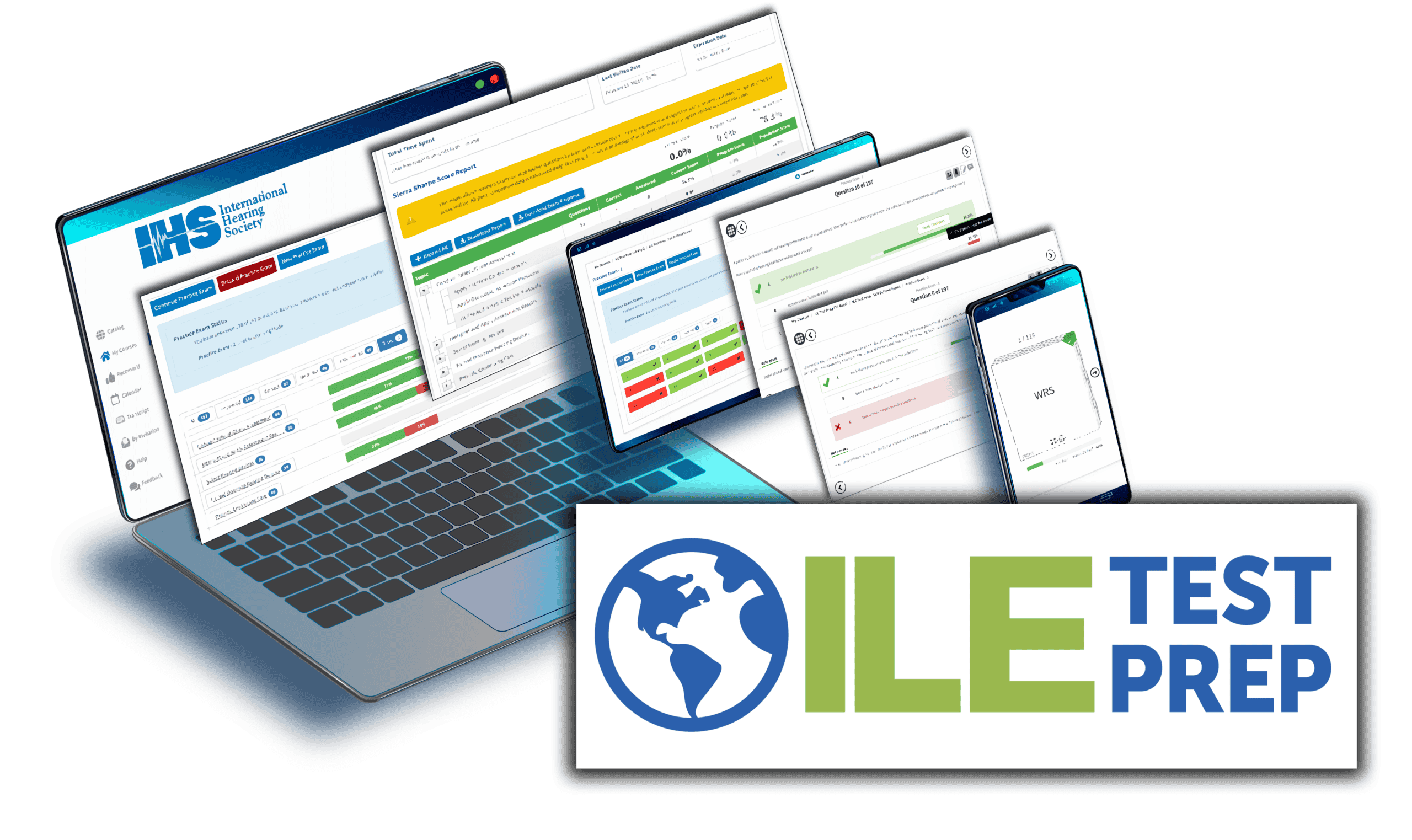
ILE Test Prep is an online prep tool specifically for the ILE. It is the only official preparation platform for the exam. ILE Test Prep offers previously-used exam questions to help you practice and become familiar with the exam.
Who is a Successful ILE Candidate?
A successful ILE candidate is knowledgeable of, and capable of, safely performing within the scope of practice permitted by the governing agency’s license. Within the permitted scope of practice, they are independently capable of:
- Determining and understanding a patient’s/client’s hearing and listening needs
- Discovering a patient’s/client’s health history
- Determining, conducting, and interpreting appropriate audiometric tests
- Selecting and fitting appropriate instrumentation and other assistive devices
- Performing proper sanitation
- Recognizing when referrals to other health care professionals – including more experienced Hearing Aid Specialists – are necessary, and working when necessary with associated healthcare professionals to help a patient/client fully understand their particular issues related to hearing and hearing loss
Taking the ILE
From key exam-day details to essential standards of conduct, please review each section carefully to ensure you’re fully informed and ready for the ILE.
Important Day-Of Information
When going to the testing center for your exam appointment:
- Bring a valid, physical, unexpired photo ID – the name on your ID must match exactly the name on your test-taker web account. If your name has changed recently, it is strongly recommended that you call IHS to confirm the name on your test-taker account prior to your exam.
- Bring your Registration Confirmation email, either printed or on your phone. Phones must be stored in your car or the secure storing area provided by the testing center after presenting the confirmation email. If you don’t have the email, check your spam/junk folder. Call IHS if you cannot locate it.
- Arrive early, giving yourself plenty of time to park and figure out where you’re going. If you arrive late, you may not be permitted to take the exam.
- Leave personal possessions at home or in your car. Any testing aids (calculator, scratch paper, etc.) are not permitted in the testing center. Most testing centers have a secure area for storing your essential items (i.e., car keys) during your test.
- You must adhere to IHS’ standards of conduct during the exam as well as any instructions or directives from testing center staff.
Need to change your exam appointment? Exams can be canceled or rescheduled up to 48 hours prior to the appointment with no added fees. If rescheduled or cancelled less than 48 hours prior to the exam appointment, you will forfeit the entire exam fee. If you have approved testing accommodations, you must contact IHS to cancel or reschedule your exam and standard fees will still apply.
IHS’ Standards of Conduct
It is imperative that all individuals in the hearing healthcare profession behave according to standards of professional conduct. IHS Members are bound by the IHS Code of Ethics. All licensees or prospective licensees are required to adhere to their jurisdiction’s codes of ethics as well as any employer code of conduct. Finally, everyone must follow all applicable laws and rules at local, state/provincial, and federal levels – including copyright laws.
Conduct rules for the ILE are strict. All exam candidates are expected to adhere to the conduct standards set forth by IHS. Any individual found to have engaged in Test Misconduct could face serious consequences. Violation of these policies and/or failure to comply with directions given at a testing center may result in:
- Disqualification of exam results
- Ejection from the testing center
- Forfeiture of exam fee(s)
- A report or complaint being made to your licensing agency
- Becoming barred from future testing
- Expulsion from IHS Membership
- Legal action from IHS
Test Misconduct is defined as conduct that is, or results in, a violation of security or disrupts the administration of an examination. Test Misconduct is unacceptable regardless of the examination. Actions that can be deemed Test Misconduct include but are not limited to:
- Using inappropriate or unauthorized test aids
- Copying answers from another test taker, or attempting to do so
- Communicating examination content to any third party
- Cheating in any other form, or attempting to do so
- Otherwise compromising the security or integrity of the exam
- Taking the exam for someone else, having someone else take the exam for you, or attempting to do either
- Giving or receiving assistance or attempting to do either. Communication in any form is not permitted during the test administration. Discussion or sharing of test content or answers during the test is prohibited. You may not disclose or discuss with anyone, including instructors, information about the questions or answers seen in your examination. This includes posting or discussing questions on the internet and social media platforms.
- Reconstructing or attempting to reconstruct exam questions during or following the exam using memory of the exam or the memory of others for any reason
- Removing or attempting to remove any portion of test content, answers, scratch paper, or notes from the exam administration by any means under any circumstances to any person or entity
- Tampering with a computer or attempting to do so
- Using study materials that contain or are suspected of containing stolen or illicit exam content
- Requesting that another candidate obtain or provide stolen exam content
- Failing to follow the proctor’s instructions
- Failing to provide acceptable identification
- Writing on anything other than paper provided by testing center staff
- Leaving the testing center during the exam session, including leaving the testing room without permission
- Creating a disturbance
If you see or learn about someone cheating and/or stealing, contact IHS immediately or submit an Anonymous Tip Form.

After the Exam
Results of the exam may be emailed to you right away, depending on your jurisdiction. If you are seeking to hold licensure in multiple jurisdictions, you will need to request a score transfer from IHS to send your results from one locality to another.
Frequently Asked Questions
To verify the process for your licensing and requirements, connect directly with the licensing agency in your state/province. For questions about the ILE, reach out to our Professional Development team.