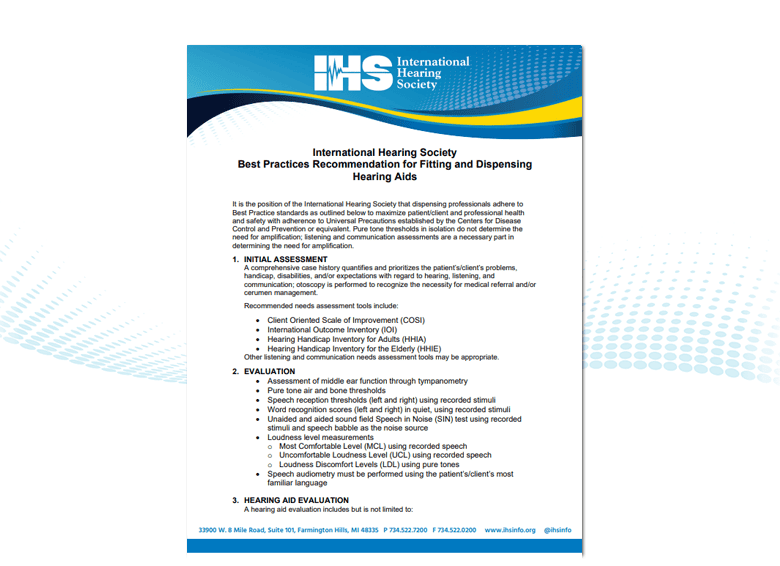
It is the position of the International Hearing Society that dispensing professionals adhere to Best Practice standards as outlined below to maximize patient/client and professional health and safety with adherence to Universal Precautions established by the Centers for Disease Control and Prevention or equivalent. Pure tone thresholds in isolation do not determine the need for amplification; listening and communication assessments are a necessary part in determining the need for amplification.
1. INITIAL ASSESSMENT
A comprehensive case history quantifies and prioritizes the patient’s/client’s problems, handicap, disabilities, and/or expectations with regard to hearing, listening, and communication; otoscopy is performed to recognize the necessity for medical referral and/or cerumen management.
Recommended needs assessment tools include:
- Client Oriented Scale of Improvement (COSI)
- International Outcome Inventory (IOI)
- Hearing Handicap Inventory for Adults (HHIA)
- Hearing Handicap Inventory for the Elderly (HHIE)
Other listening and communication needs assessment tools may be appropriate.
2. EVALUATION
- Assessment of middle ear function through tympanometry
- Pure tone air and bone thresholds
- Speech reception thresholds (left and right) using recorded stimuli
- Word recognition scores (left and right) in quiet, using recorded stimuli
- Unaided and aided sound field Speech in Noise (SIN) test using recorded stimuli and speech babble as the noise source
- Loudness level measurements
- Most Comfortable Level (MCL) using recorded speech
- Uncomfortable Loudness Level (UCL) using recorded speech
- Loudness Discomfort Levels (LDL) using pure tones
- Speech audiometry must be performed using the patient’s/client’s most familiar language
3. HEARING AID EVALUATION
A hearing aid evaluation includes but is not limited to:
- Establishing realistic expectations
- Determining hearing aid candidacy
- Selecting styles, couplers, and circuitry
- Selecting wireless streaming options such as Bluetooth®, FM and/or digital remote microphones (RM), telecoils (T-coil), assistive listening devices (ALD) and other accessories
4. HEARING AID FITTING AND DISPENSING
Protocols include but are not limited to the following:
- Confirm manufacturer’s hearing aid specifications in hearing aid test box
- Confirm physical fit and comfort
- Instruct and demonstrate
- Use and care of the instruments and accessories
- Telephone use
- Use in challenging acoustic environments
- Realistic expectations
- Verify electroacoustic characteristics using probe microphone measurements
- Schedule a post-fitting care visit
5. POST-FITTING CARE
To ensure the success of the hearing aid fitting, post-fitting care protocols include but are not limited to the following:
- Validate outcomes with respect to the initial needs assessment
- Counsel regarding realistic expectations and successful hearing aid use
- Make electroacoustic modifications as needed, followed by verification
- Review the following:
- Daily care of the hearing aids
- Maintenance schedule
- Warranty
- Battery options and use
- Follow-up visits
REFERENCES
Galster, J.A. (2018). Audiology Treatment. New York: Thieme Publishers.
Gelfand, S. (2016). Essentials of Audiology. New York: Thieme Publishers.
Hamill, T.A. and Prince, L.L. (2017). The Hearing Sciences, 3rd Edition. San Diego, CA: Plural
Publishing, Inc.
International Hearing Society. (2016). Professional Training Textbook in Hearing Health
Sciences. Hayden-McNeil: Plymouth, MI.
International Hearing Society. (2016). Professional Training Workbook in Hearing Health
Sciences. Hayden-McNeil: Plymouth, MI.
Kramer, S., Brown, D.K., & Small, L. (2018). Audiology: Science to practice, 3rd Edition. San
Diego, CA: Plural Publishing, Inc.
Ricketts, T.A., Bentler, R., & Mueller, H.G. (2018). Essentials of Modern Hearing Aids: Selection,
Fitting, and Verifications. San Diego, CA: Plural Publishing, Inc.
IHS Code of Ethics