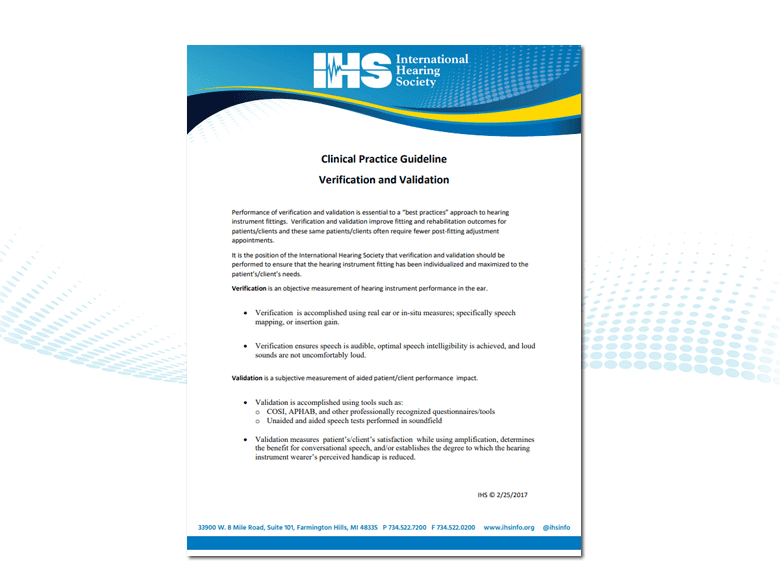
Performance of verification and validation is essential to a “best practices” approach to hearing instrument fittings. Verification and validation improve fitting and rehabilitation outcomes for patients/clients and these same patients/clients often require fewer post-fitting adjustment appointments.
It is the position of the International Hearing Society that verification and validation should be performed to ensure that the hearing instrument fitting has been individualized and maximized to the patient’s/client’s needs.
Verification is an objective measurement of hearing instrument performance in the ear.
- Verification is accomplished using real ear or in-situ measures; specifically speech mapping, or insertion gain.
- Verification ensures speech is audible, optimal speech intelligibility is achieved, and loud sounds are not uncomfortably loud.
Validation is a subjective measurement of aided patient/client performance impact.
- Validation is accomplished using tools such as:
- COSI, APHAB, and other professionally recognized questionnaires/tools
- Unaided and aided speech tests performed in soundfield
- Validation measures patient’s/client’s satisfaction while using amplification, determines the benefit for conversational speech, and/or establishes the degree to which the hearing instrument wearer’s perceived handicap is reduced.