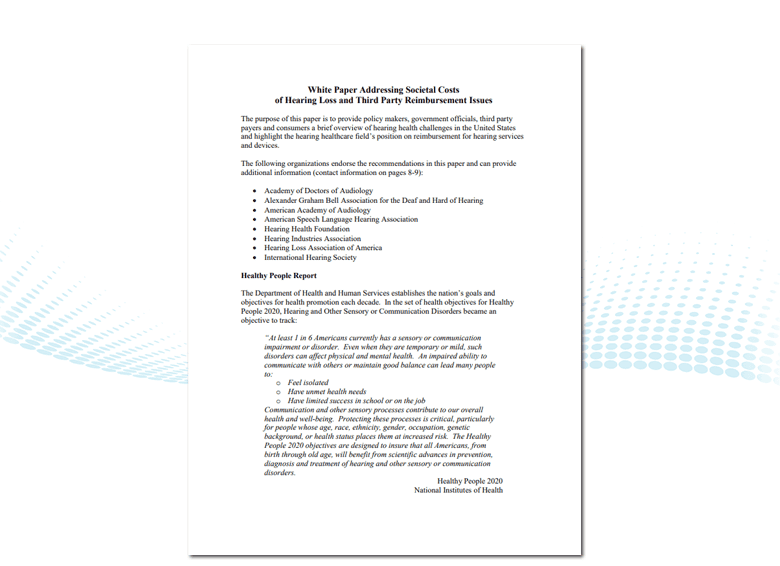
The purpose of this paper is to provide policy makers, government officials, third party payers and consumers a brief overview of hearing health challenges in the United States and highlight the hearing healthcare field’s position on reimbursement for hearing services and devices.
The following organizations endorse the recommendations in this paper and can provide additional information:
- Academy of Doctors of Audiology
- Alexander Graham Bell Association for the Deaf and Hard of Hearing
- American Academy of Audiology
- American Speech Language Hearing Association
- Hearing Health Foundation
- Hearing Industries Association
- Hearing Loss Association of America
- International Hearing Society
Healthy People Report
The Department of Health and Human Services establishes the nation’s goals and objectives for health promotion each decade. In the set of health objectives for Healthy People 2020, Hearing and Other Sensory or Communication Disorders became an objective to track:
“At least 1 in 6 Americans currently has a sensory or communication impairment or disorder. Even when they are temporary or mild, such disorders can affect physical and mental health. An impaired ability to communicate with others or maintain good balance can lead many people to:
- Feel isolated
- Have unmet health needs
- Have limited success in school or on the job
Communication and other sensory processes contribute to our overall health and well-being. Protecting these processes is critical, particularly for people whose age, race, ethnicity, gender, occupation, genetic background, or health status places them at increased risk. The Healthy People 2020 objectives are designed to insure that all Americans, from birth through old age, will benefit from scientific advances in prevention, diagnosis and treatment of hearing and other sensory or communication disorders.
Healthy People 2020
National Institutes of Health
The Healthy People 2010 report also focused on the importance of hearing health:
Among the five senses, people depend on vision and hearing to provide the primary cues for conducting the basic activities of daily life. At the most basic level, vision and hearing permit people to navigate and to stay oriented within their environment. These senses provide the portals for language, whether spoken, signed, or read. They are critical to most work and recreation and allow people to interact more fully. For these reasons, vision and hearing are defining elements of the quality of life. Either, or both, of these senses may be diminished or lost because of heredity, aging, injury, or disease. Such loss may occur gradually, over the course of a lifetime, or traumatically in an instant. Conditions of vision or hearing loss that are linked with chronic and disabling diseases pose additional challenges for patients and their families. From the public health perspective, the prevention of either the initial impairment or additional impairment from these environmentally orienting and socially connecting senses requires significant resources. Prevention of vision or hearing loss or their resulting disabling conditions through the development of improved disease prevention, detection, or treatment methods or more effective rehabilitative strategies must remain a priority.”
Healthy People 2010
National Institutes of Health
Hearing Loss and Hearing Aids
According to the National Institute on Deafness and other Communication Disorders, there are over 36 million Americans with hearing loss, 10 % of the US population.1 Additionally, a study lead by Johns Hopkins researchers estimates that 1 in 5 Americans 12 and over, some 48 million people, have a hearing loss, while 1 in 8 Americans have a hearing loss in both ears. 2 Deafness or hearing impairment may be caused by genetic factors, noise, trauma, certain drugs or medications, as well as viral or bacterial infections.3 According to AARP, hearing loss is the third most prevalent chronic health condition facing seniors.4 There is, in fact, a high correlation between aging and hearing loss, and one out of three older Americans has this condition. Over the next 15 years, 78 million people will move into the 60+ age bracket and the incidence of hearing loss will indeed escalate well beyond the current 1 in 10 affected persons.5 Among adults age 70 and older with hearing loss who could benefit from hearing aids, fewer than one in three (30%) has ever used them. Even fewer adults age 20-69 (approximately 16%) who could benefit from wearing aids have ever used them.6 The result of this demographic shift will place greater demands on all age-related health care issues, particularly on hearing health care.
According to a major study published in the Journal of the American Medical Association, hearing aids provide a significant benefit to individuals with hearing loss.7 Hearing aids are the treatment of choice for more than 80% of hearing losses; however, only about 25% of the estimated 36 million Americans who could benefit by using hearing aids, including those with mild hearing loss, currently own them. 8 Also, less than 20% of general physical exams include any type of hearing assessment, exacerbating the challenge of identification and treatment.9 Furthermore, several recent studies have substantiated negative psychological and emotional changes with untreated hearing losses that are reversible with hearing aids. 10
Although not the sole cause of underutilization, a lack of payment assistance for hearing devices is a major factor in the low rate of ownership and use. While the Veterans Health Administration provided over 615,000 hearing aids to hearing impaired veterans in 2013, 11 and local, state and federal governments purchase a range of assistive listening devices for schools and other public accommodations, there is little or no coverage for individuals accessing hearing health services or hearing aids through private health insurance and Medicare. The hearing health care delivery system in the United States has many interrelated issues that make access confusing, difficult and expensive. Medical economics, quality of care, social impact, patient access, follow-up care, provider training and qualifications are all part of this puzzle. The system is further complicated by a matrix of national, state, and local rules and regulations.
The Economic and Societal Costs of Hearing Impairment
Infants and Children – Million Dollar Babies
The most critical period for the development of language is during the first 3 years of life, as this is the period when the brain is developing. The skills associated with the effective acquisition of language depend on exposure to, and manipulation of, these communication tools. Early identification of deafness or hearing loss is critical in preventing or ameliorating language delay or disorder in children who are deaf or hard of hearing and allows for appropriate intervention or rehabilitation. Early identification and intervention have lifelong implications for language development.12 Newborn hearing screening is the standard of care in hospitals nationwide. In 2011, 97.9% of babies born in the U.S. had their hearing screened in the first few weeks of life.13 The primary purpose of newborn hearing screening is to identify newborns who are likely to have hearing loss and who require further evaluation. A secondary objective is to identify newborns with medical conditions that can cause late-onset hearing loss and to establish a plan for ongoing monitoring of their hearing status.14 Infants who do not pass the newborn hearing screening (and/or rescreening) are referred immediately for a comprehensive audiologic evaluation, with a goal of having hearing loss confirmed by three months of age.
Estimates of congenital hearing loss based on data from States with universal newborn screening programs place this number at 2 to 3 per 1,000 live births. These data do not include children who are born with normal hearing and have late-onset or progressive hearing loss. Hearing loss often is sufficient to prevent the spontaneous development of spoken language. More than 50 percent of childhood hearing impairments are believed to be of genetic origin, and earliest possible identification of infant hearing loss has been widely endorsed as critical for the developing child.
Minimal hearing loss also is an important factor in school success and psychosocial development.15 Early identification of hearing loss and treatment in newborns has a dramatic and positive impact on speech development, language development, and learning. Even a six-month delay in treatment of newborns can make the difference between a special education and a mainstream education. According to a 1993 study by the Marion Downs Center, children who do not require special education save a school system as much as $348,000 during a 12-year education.16 The lifetime costs of profound hearing loss, according to the Downs study, can total as much as $1 million.17
Long-term studies indicate that delays in treatment result in the inability of children with hearing loss to reach the academic level of their peers. This also has psychosocial consequences, although the true social cost of low peer group acceptance is undetermined. For newborns, the argument is so compelling that all 50 states and the District of Columbia have Early Hearing Detection and Intervention (EHDI) laws or voluntary compliance programs that screen hearing. This infant screening was an easily justifiable decision for policy and decision makers. However, early identification must be partnered with amplification, aural rehabilitation, speech therapy and other treatments.
Adults – Productivity and Effects on Lifestyle
Approximately 10 million persons in the United States have permanent, irreversible hearing loss due to noise or trauma.18 Additionally, 30 million people are estimated to be exposed to injurious levels of noise each day. Noise-induced hearing loss (NIHL) is the most common occupational disease and the second most self-reported occupational illness or injury.19 In industry-specific studies, 44 percent of carpenters and 48 percent of plumbers reported they had a perceived hearing loss.20 Ninety percent of coal miners are estimated to have a hearing loss by age 52 years,21 and 70 percent of male miners will experience a hearing loss by age 60 years.22
Data indicate that people are losing hearing earlier in life and that men are more frequently affected in the 35- to 60-year-old age group.23 Findings from the National Health and Nutrition Examination Survey indicated that 14.9% of children between 6 and 19 years of age had a hearing loss of at least 16 dB in either low or high frequencies; the majority of these losses were classified as slight (16-25 dB).24 Hearing loss of at least 25 dB at the speech frequencies has been reported in 29% of adults 50-59 years old, in 49% of adults 60-69 years old, and in 63.1% of adults ages 70+.2526
Noise-induced hearing loss can be the result of a traumatic sudden level of impulse noise, such as an explosion, that can leave an individual immediately and permanently deafened; the result of continuing exposure to high levels of sound in the workplace or in recreational settings; the consequence of years of noise exposure causing subtle, progressive damage; or exacerbated due to individual vulnerability to noise. Noise-induced hearing loss is related to noise level, proximity to the harmful sound, duration of exposure, and individual susceptibility. Many of these causes can be controlled by prevention. Prevention of noise-induced hearing loss is imperative for people both on and off the job.
Noise-induced hearing loss is also an increasing concern for children and adolescents. Studies estimated that 12.5% of U.S. children (ages 6-19) have evidence of noise-induced hearing threshold change.27
While there exists a strong correlation between aging and hearing problems, the majority (65%) of people with hearing loss are younger than age 65 and are active in the work force.28 Noise exposure, aging and genetic predisposition place this group at risk.
According to the Project Hope Study, those with a severe hearing loss still in the workplace are expected to earn only 50-70 percent of their non-hearing impaired peers and lose between $220,000 and $440,000 in earnings over their working life.29 Unfortunately, these costs only cover earning potential and neglect intangible losses, such as the social isolation and psychological stress imposed by hearing impairment.
Prevalence of hearing loss increases dramatically with age. National survey results show that in the population of those with hearing impairment, only 2% were born with a hearing impairment; 4% to 6% developed a hearing loss after birth and before 6 years; 11% to 12% developed hearing loss between ages 6 and 19 years; 50% to 64% developed hearing loss between ages 20 to 59 years; and 20% to 30% developed hearing loss at or after the age of 60.30
Older people also are a major concern in terms of hearing health disparity. Presbycusis, the loss of hearing associated with aging, affects about 30 percent of adults who are age 65 years and older.31 About half of the population over age 75 years has a significant hearing loss.32 As the population ages with greater longevity, these numbers are increasing. Only about one-fourth of those who could benefit from a hearing aid actually use one.33 More than 8 percent of the population aged 70 years and older report both hearing and vision impairment.34
Hearing loss adversely affects quality of life according to a 1998 study by the National Council on the Aging (NCOA). The study, which surveyed 2069 individuals with hearing loss and 1710 of their family members, revealed that hearing aid users are likely to report better physical, emotional, mental and social well-being than those who do not use hearing aids.35 Conversely, those that do not take advantage of treatment and amplification are likely to place unnecessary additional cost on both private insurance and Medicare.
Studies link untreated hearing loss to increased dementia risk
Numerous studies have linked untreated hearing loss to other serious conditions which are significant issues for people, especially older Americans who rely on Medicare and who are more likely to have hearing loss. Approximately one third of people between 65 and 74 and nearly half of those over 75 have hearing loss.36 It has been demonstrated that the symptoms of depression are reduced, and quality of life improved for people with hearing loss who use hearing aids.37 In addition, research has indicated that dementia risk may be up to five times greater for people who do not address their hearing loss.38 Also, untreated hearing loss is connected to a tripling of the risk for falling, which is of special concern to older Americans.39
The Solution – National System Support for Early Identification, Patient Participation & Professional Treatment
The Hearing Health Community Believes That The Following Actions Will Contribute To A Successful National Hearing Health Policy:
- Continue & Enhance Universal Infant Hearing Screening in all States
- Increase Educational Focus on School Hearing Testing Programs
- Include Mandatory Hearing Loss Prevention Education for Elementary through High School students.
- Extend OSHA Guidelines for Work Place Hearing Testing and Monitoring to incorporate treatment
- Enhance Medical school curriculum and continuing education for family physicians that increases the inclusion of hearing screening as part of Routine Physical Exams particularly for infants, school age children, adults over the age of fifty, and those in high risk groups from occupation or genetics.
- Broaden public education about the symptoms of untreated hearing loss and the appropriate steps to treat hearing problems. The National Institute on Deafness and Other Communication Disorder’s mission and organization are well-suited to lead this national effort.
The Hearing Health Community Recommends The Development Of A National Hearing Healthcare Reimbursement Policy That Embraces The Following Key Principles:
Provider Choice
The ingredients of successful adaptation to hearing aids are not only appropriate technology, but also provider service. Closed provider networks limit access to the full range of technology and professional services. In the case of hearing aids and implants, evaluation, recommendation and selection by a licensed provider, quality of care and follow-up treatment plays a critical role in outcome. Patients should be allowed to select their hearing healthcare providers and those providers should be qualified through state licensure.
Patient Participation in Treatment Options
Technology, science and medicine are making rapid advances and patients should have access to the full range of these advances. Whether economically advantaged or disadvantaged, or enrolled in Medicaid or a commercial plan, people should have the right to participate in the selection of their hearing devices. Any reimbursement system should allow the patient to choose to upgrade the type of instrument and/or technology they desire if it is recommended by the hearing healthcare professional and the individual pays the difference.
Quality Component
Hearing healthcare providers have the responsibility to deliver quality hearing care. Providers should follow professional best practice guidelines, adhere to well-developed standards of care and demonstrate patient benefits with acceptable, appropriate outcome measures. Hearing device manufacturers must be able to demonstrate the efficacy of their devices with independent clinical studies substantiating patient benefits.
Medically Effective Treatment
Fiscally responsible, medically effective treatment is one of the goals of health care in the United States. Hearing health care is no exception. Price transparency, reimbursement levels, initial & renewal insurance eligibility procedures, and patient co-pay must be established within the context of budget boundaries. Regardless of the level of reimbursement, patients deserve the highest quality of hearing healthcare and qualified providers and hearing device manufacturers strive to ensure that the value of hearing healthcare is recognized and understood by patients, insurers, the government, and other healthcare providers.
CONCLUSION
In a plethora of studies, it has been proven that the use of hearing aids and implantable devices by Americans with hearing loss improves quality of life and reduces societal costs of caring for those with hearing loss. Indeed, in the case of infants and children, the early diagnosis and treatment of hearing loss can substantially improve development and academic achievement. The treatment of hearing loss provides for a return on the investment many times the cost of the treatment and improves the quality of life for millions of Americans. It is incumbent on policymakers, both in the public and private sectors, to acknowledge the benefit that hearing devices provide and develop programs that allow those in need of treatment to access these technologies as part of a wider healthcare policy agenda.
Contacts
as of January 2015
Alexander Graham Bell Association for the Deaf and Hard of Hearing
Contact: Emilio Alonso-Mendoza, Executive Director
Tel: 202-337-5220,
ealonsomendoza@agbell.org
American Academy of Audiology
Contact: Tanya Tolpegin, Executive Director
Tel: 703-790-8466,
ttolpegin@audiology.org
Academy of Doctors of Audiology
Contact: Stephanie Czuhajewski, Executive Director
866-493-5544,
sczuhajewski@audiologist.org
American Speech Language Hearing Association
Contact: Ingrida Lusis, Director of Federal & Political Advocacy
Tel: 202-624-5959,
llusis@asha.org
Hearing Health Foundation
Contact: Claire Schultz, Executive Director
Tel: 212-257-6140
cschultz@hearinghealthfoundation.org
www.hearinghealthfoundation.org
Hearing Industries Association
Contact: Andy Bopp, Executive Director
Tel: 202-712-9041,
abopp@bostrom.com
Hearing Loss Association of America
Contact: Anna Gilmore Hall, Executive Director
Tel: 301-657-2248 (Voice) 2249 (TTY),
agilmorehall@hearingloss.org
International Hearing Society
Contact: Kathleen Mennillo, Executive Director
Tel: 734-522-7200,
kmennillo@ihsinfo.org
References
1 National Institute on Deafness and Other Communication Disorders (NIDCD). National Strategic Research Plan: Hearing and Hearing Impairment. Bethesda, MD: HHS, NIH, 2010.
2 Lin, Frank.; Niparko, John.; Ferruci, Luigi. Hearing Loss Prevalence in the United States. Archives of Internal Medicine 171(20): 1851-2, 2011.
3 National Institutes of Health, Healthy People 2010 Program, Volume 28.
5 U.S. Census Bureau
6 “Quick Statistics.” NIDCD Health Information. National Institutes of Health, 3 Oct. 2014. Web. < https://www.nidcd.nih.gov/health/statistics/pages/quick.asp >
7 Larson, PhD, Vernon et. al., Efficacy of 3 Commonly Used Hearing Aid Circuits, Journal of the American Medical Association, October 11, 2000, Vol. 284, No. 14.
8 Kochkin PhD, Sergei, MarkeTrak VIII The Key Influencing Factors in Hearing Aid Purchase Intent, p. 1.
9 Kochkin PhD, Sergei & Rogin MA, Carole, Quantifying the Obvious: The Impact of Hearing Instruments on Quality of Life, The Hearing Review, p. 10
10 Ibid, page 18
11 Hearing Industries Association, 2014 Industry Statistical Program.
12 National Institutes for Health, Healthy People 2010.
13 Centers for Disease Control and Prevention (CDC), 2011
14 Joint Committee on Infant Hearing (JCIH), 2007
15 Ibid.
16 Downs, MP, Universal Newborn Hearing Screening: The Colorado Study, International Journal of Pediatric Otorhinolaryngology, 1995, page 32.
17 Ibid.
18 NIDCD. Fact Sheet on Noise-Induced Hearing Loss. Washington, DC: HHS, 1998.
19 National Institute for Occupational Safety and Health (NIOSH). Fact Sheet: Work-Related Hearing Loss. Washington, DC: HHS, 1999.
20 Lusk, S.L.; Kerr, M.J.; and Kauffman, S.A. Use of hearing protection and perceptions of noise exposure and hearing loss among construction workers. American Industrial Hygiene Association Journal 59:566-570, 1998.
21 Franks, J.R. Analysis of Audiograms for a Large Cohort of Noise-Exposed Miners. Cincinnati, OH: HHS, Centers for Disease Control and Prevention, NIOSH, Division of Biomedical and Behavioral Science, 1996.
22 Mine Safety and Health Administration. Health Standards for Occupational Noise Exposure in Coal, Metal, and Nonmetal Mines: Proposed Rule. Federal Register 61:243:66347-66397, December 17, 1996.
23 Wallhagen, M.I.; Strawbridge, W.J.; Cohen, R.D.; et al. An Increasing prevalence of hearing impairment and associated risk factors over three decades of the Alameda County Study. American Journal of Public Health 87(3):440-442, 1997.
24 Niskar A,; Kieszak SM.; et al. Prevalence of Hearing Loss Among Children 6 to 19 Years of Age: The Third National Health and Nutrition Examination Survey. JAMA 279.14 (1998): 1071-1075.
25 Agrawal Y, Platz EA, Niparko JK. Prevalence of Hearing Loss and Differences by Demographic Characteristics Among US Adults: Data From the National Health and Nutrition Examination Survey, 1999- 2004. Arch Intern Med. 2008;168(14):1522-1530.
26 Lin, F.; Thorpe, R.; Gordon-Salant, S.; Ferruci, L. Hearing loss prevalence and risk factors among older adults in the United States. The Journals of Gerontology. Series A, Biological Sciences and Medical Sciences. 66.5 (2011): 592-90.
27 Niskar, AS.; Kieszak, SM.; et al. Estimated prevalence of noise induced hearing threshold shifts among children 6 to 19 years of age: The third national health and nutritional examination survey. 1988-1994, United States. Pediatrics 2001;108: 40–43.
28 Kochkin, Ph.D., Sergei, Better Hearing Institute, Washington, DC- MarkeTrak survey (2004)
29 Mohr, Feldman, Dunbar, The Societal Costs of Severe to Profound Hearing Loss in the United States, Project Hope Policy Analysis Brief, April, 2000, Volume 2, No. 1.
30 “Age at Which Hearing Loss Begins.” NIDCD Health Information. National Institutes of Health, 7 June 2010. Web. < https://www.nidcd.nih.gov/health/statistics/Pages/begins.aspx >
31 Gates, G.A.; Cooper, Jr., J.C.; Kannel, W.B.; et al. Hearing in the elderly: The Framingham Cohort, 1983– 1985. Part I. Basic audiometric test results. Ear and Hearing 11(4):247-256, 1990.
32 Cruickshanks, K.J.; Wiley, T.L.; Tweed, T.S.; et al. Prevalence of hearing loss in older adults in Beaver Dam, Wisconsin: The Epidemiology of Hearing Loss Study. American Journal of Epidemiology 148(9):879- 886, 1998.
33 Popelka, M.M.; Cruickshanks, K.J.; Wiley, T.L.; et al. Low prevalence of hearing aid use among older adults with hearing loss: The Epidemiology of Hearing Loss Study. Journal of the American Geriatrics Society 46(9):1075-1078, 1998.
34 Klein, R.; Cruickshanks, K.F.; Klein, B.E.K.; et al. Is age-related maculopathy related to hearing loss? Archives of Ophthalmology 116(3):360-365, 1998.
35 See Kochkin & Rogin, page 13.
36 National Institute of Deafness and Other Communication Disorders (NIDCD), 2010.
37 Boi, Raffaella.; Raca, Luca; et. al. Hearing loss and depressive symptoms in elderly patients. Geriatrics and Gerontology International 12(3):440-445, 2012.
38 Lin, Frank. Hearing Loss in Older Adults: Who’s Listening? The Journal of the American Medical Association 307(11): 1147-1148, 2012. 39 Lin, Frank,; Ferrucci, Luigi. Hearing Loss and Falls Among Older Adults in the United States. Archives of Internal Medicine. 172(4): 369-371, 2012.