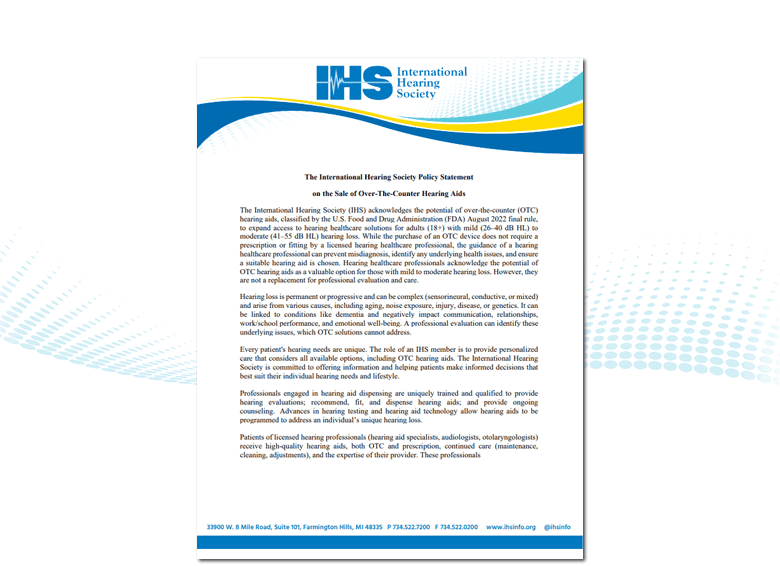
The International Hearing Society (IHS) acknowledges the potential of over-the-counter (OTC) hearing aids, classified by the U.S. Food and Drug Administration (FDA) August 2022 final rule, to expand access to hearing healthcare solutions for adults (18+) with mild (26–40 dB HL) to moderate (41–55 dB HL) hearing loss. While the purchase of an OTC device does not require a prescription or fitting by a licensed hearing healthcare professional, the guidance of a hearing healthcare professional can prevent misdiagnosis, identify any underlying health issues, and ensure a suitable hearing aid is chosen. Hearing healthcare professionals acknowledge the potential of OTC hearing aids as a valuable option for those with mild to moderate hearing loss. However, they are not a replacement for professional evaluation and care.
Hearing loss is permanent or progressive and can be complex (sensorineural, conductive, or mixed) and arise from various causes, including aging, noise exposure, injury, disease, or genetics. It can be linked to conditions like dementia and negatively impact communication, relationships, work/school performance, and emotional well-being. A professional evaluation can identify these underlying issues, which OTC solutions cannot address.
Every patient’s hearing needs are unique. The role of an IHS member is to provide personalized care that considers all available options, including OTC hearing aids. The International Hearing Society is committed to offering information and helping patients make informed decisions that best suit their individual hearing needs and lifestyle.
Professionals engaged in hearing aid dispensing are uniquely trained and qualified to provide hearing evaluations; recommend, fit, and dispense hearing aids; and provide ongoing counseling. Advances in hearing testing and hearing aid technology allow hearing aids to be programmed to address an individual’s unique hearing loss.
Patients of licensed hearing professionals (hearing aid specialists, audiologists, otolaryngologists) receive high-quality hearing aids, both OTC and prescription, continued care (maintenance, cleaning, adjustments), and the expertise of their provider. These professionals stay current through ongoing hearing healthcare education, competency testing, and state licensing/certification requirements. Additionally, advanced certification programs are available.
For optimal effectiveness, OTC users need proper education on use and maintenance. Without guidance, they risk misuse or underutilization, potentially diminishing benefits or neglecting the root cause of their hearing loss. For this reason, the IHS actively participated in developing FDA consumer resources for hearing health to address this need.
Therefore, IHS emphasizes the importance of educating consumers about OTC device limitations and appropriately-programmed hearing aids, along with ongoing patient counseling, fitting, and adjustments, by a member of IHS or another state-licensed/certified hearing healthcare professional is essential to maximizing one’s success with hearing aids and living with hearing loss.
Hearing healthcare professionals acknowledge the potential of OTC hearing aids to fill a gap in the market. However, they emphasize the importance of maintaining high standards of care and ensuring that consumers are informed about the limitations of these devices.