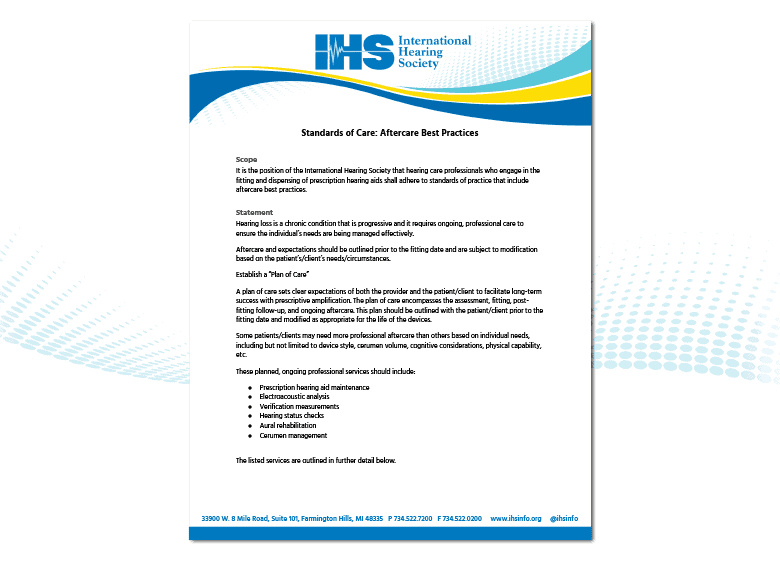
Scope
It is the position of the International Hearing Society that hearing care professionals who engage in the fitting and dispensing of prescription hearing aids shall adhere to standards of practice that include aftercare best practices.
Statement
Hearing loss is a chronic condition that is progressive and it requires ongoing, professional care to ensure the individual’s needs are being managed effectively.
Aftercare and expectations should be outlined prior to the fitting date and are subject to modification based on the patient’s/client’s needs/circumstances.
Establish a “Plan of Care”
A plan of care sets clear expectations of both the provider and the patient/client to facilitate long-term success with prescriptive amplification. The plan of care encompasses the assessment, fitting, post-fitting follow-up, and ongoing aftercare. This plan should be outlined with the patient/client prior to the fitting date and modified as appropriate for the life of the devices.
Some patients/clients may need more professional aftercare than others based on individual needs, including but not limited to device style, cerumen volume, cognitive considerations, physical capability, etc.
These planned, ongoing professional services should include:
- Prescription hearing aid maintenance
- Electroacoustic analysis
- Verification measurements
- Hearing status checks
- Aural rehabilitation
- Cerumen management
The listed services are outlined in further detail below.
Maintenance of Prescription Hearing Aids
Maintenance of prescription hearing aids is often referred to as a clean and check, hearing aid check, or hearing aid cleaning. The need for this service is dependent on the patient’s/client’s ability to do at-home care, the type/style of hearing aid, and the condition of the wearer’s ear(s). This service may include:
- Otoscopic inspection of the ear(s)
- Listening check to assess functionality and/or confirm patient/client report(s)
- Comprehensive visual inspection of hearing aid condition
- Removal of foreign material from the hearing aid
- Replacement of parts
- Hearing aid firmware updates
- Connectivity assistance
- Troubleshooting
- Counseling related to hearing aid use and care
Routine prescription hearing aid maintenance should be performed a minimum of two times per year, and more often as professionally indicated, with appropriate documentation.
Hearing Aid Firmware Updates
The professional shall complete any available hearing aid firmware updates when prompted by the fitting software.
Electroacoustic Analysis (EAA)
Many wearers are unable to identify diminishing sound quality of their prescription hearing aids until the damage is beyond a simple cleaning or in-office parts change. Use of prescription hearing aids that do not comply with manufacturer specifications can negatively impact the wearer. Despite the manufacturer’s quality control efforts, new and repaired hearing aids have a high probability of noncompliance with standards as set by the American National Standards Institute (ANSI). Additionally, moisture and humidity have a known effect on hearing aid performance. Therefore, it is important that providers perform EAA (including counseling on hearing aid performance, use, and care) at least annually to determine that the prescription hearing aids are functioning as intended. More frequent testing may be required whenever the following conditions occur:
- Upon receipt from the manufacturer
- Wax found on the receiver
- Substantial moisture removal (>1uL)
- Patient/client report of showering/swimming with hearing aid(s)
- Patient/client report of a reduced sound perception or new sound distortion
- In office repair (to confirm device has been repaired to standard)
Verification Measurements1
The use of probe microphone measures is the current standard of care when it comes to verifying the hearing aid is meeting the patient’s/client’s prescriptive target. However some patients/clients may not tolerate the full prescription at the initial hearing aid fitting.
Additional verification measures should be completed whenever:
- The programming of the hearing aids is adjusted due to patient/client acclimatization
- The coupler has been modified (diameter, venting, manufacturer, etc.)
- The receiver gain (matrix) has been changed
- There has been a change in hearing that warrants a change in programming
- The patient’s/client’s word recognition has statistically changed (using Thornton and Raffin’s table)
- The patient/client requests modifications to their programming
- Comparing EAA/HIT results to complete RECD testing
- Indicated for counseling purposes
Verification measurements should be completed using the most up-to-date audiometric findings available.
Hearing Status Checks
Monitoring a patient’s/client’s hearing is an important aspect of ensuring they are getting the most benefit from their hearing aids. Patients/clients with documented hearing loss should have their hearing tested every two years.
Certain medical conditions and/or environmental factors increase the likelihood that one’s hearing declines more rapidly than the population average. Therefore, patients/clients should have their hearing re-evaluated annually when the below conditions are present until the patient/client shows three (3) consecutive evaluations with no clinically significant change to their hearing:
- They completed their first year of hearing aid use
- An asymmetrical loss is present without a negative MRI on file
- The patient/client has a comorbid and/or chronic condition, including but not limited to:
- Cardiovascular disease
- Diabetes
- Ongoing environmental toxin exposure
- Osteoarthritis
- Chronic kidney disease
- Hypertension
- Autoimmune disorders (Rheumatoid Arthritis, Hashimoto’s, Lupus, Myasthenia Gravis, etc.)
- Meniere’s Disease
- The patient/client is using or exposed to potentially ototoxic substances/treatments.
- As ordered/directed by an ENT
Additionally, there may be circumstances that prompt a hearing evaluation to be completed sooner than biennially. The exact timing of and the need for these evaluations are determined by the individual patient’s/client’s situation.
Auditory Rehabilitation
The type, frequency, and duration of auditory rehabilitation practices recommended for each patient/client are determined by the professional.
While/after auditory rehabilitation is performed, the professional should follow-up with the patient/client to verify that the recommended strategies are showing benefit.
The minimum frequency that hearing aid specialists should monitor the efficacy of auditory rehabilitation is six months, and it can be monitored more frequently if that patient’s/client’s regularly scheduled appointments are sooner than six months.
Cerumen Management
Cerumen management encompasses removal of cerumen from hearing aids and/or from the ear.
The professional engaged in cerumen management as part of their patient aftercare may perform multiple services, including but not limited to:
- Removal of cerumen from the ear
- Removal of cerumen from the hearing aid
- Providing referrals to medical professionals when indicated
- Recommending over-the-counter solutions as applicable
- Maintenance of the hearing aid such as changing wax guard, changing filters, and cleaning
- Providing relevant resources, counseling, and education to patients/clients who require additional cerumen-related care
Cerumen management should be completed whenever cerumen is interfering with the function of prescribed hearing aids and/or the patient’s/client’s hearing, or as determined by the provider.
At every patient/client visit, the provider should review the patient’s/client’s status and determine whether cerumen management must be performed.
Statement approved by the IHS Board of Governors, April 13, 2026.
- Verification Measurements can also be referred to as Conformity Evaluations or Conformity Examinations. ↩︎